A missing tooth can affect how you eat, speak, and feel when you smile. But the right restoration is not always the biggest one. When comparing single versus full arch implants, the most important question is not which treatment sounds more dramatic. It is which solution protects your oral health, fits your goals, and gives you a result you can feel confident living with for years.
For Americans considering implant treatment in Istanbul, that decision also shapes the scope of care, the number of appointments, travel timing, and overall investment. A thoughtful plan begins with a clinical assessment, not a one-size-fits-all package.
Single Versus Full Arch Implants: The Core Difference
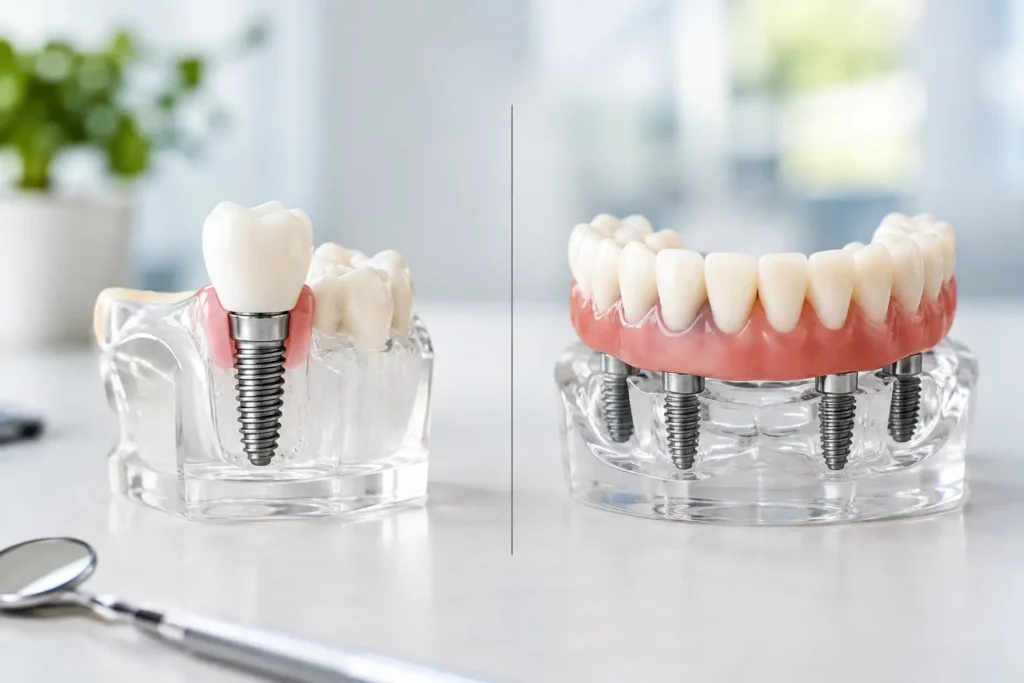
A single dental implant replaces one missing tooth. A titanium or zirconia implant post is placed in the jawbone, then restored with a custom crown after the healing process or, in selected cases, with a temporary tooth sooner. The goal is precise: replace the missing tooth without involving healthy neighboring teeth.
Full arch implants restore an entire upper or lower row of teeth. Rather than placing an implant for every tooth, an elite implant team typically uses several strategically positioned implants to support a fixed full-arch bridge. You may hear terms such as All-on-4 or All-on-6, which describe common approaches based on the number and placement of supporting implants.
The difference is not simply one tooth versus many teeth. Single implants are designed for localized tooth loss. Full-arch treatment is designed for extensive tooth loss, failing teeth, unstable dentures, or a dentition that is no longer predictable to maintain. Both can deliver highly aesthetic, functional results when planned around the patient rather than the procedure.
When a Single Implant May Be the Better Choice
If you have one missing tooth, or a small number of missing teeth separated by healthy natural teeth, a single implant is often the most conservative option. It can preserve the bone in the area of the missing root and avoid preparing adjacent teeth for a conventional bridge.
A single implant may be especially appropriate when the surrounding gums are healthy, the adjacent teeth are stable, and there is sufficient bone for implant placement. Your dentist will assess bone volume, bite forces, gum condition, medical history, and the position of the missing tooth. Front teeth demand exceptional attention to gum contours and color matching, while back teeth must withstand stronger chewing pressure.
The appeal is clear: you retain as much healthy natural tooth structure as possible. A properly designed implant crown can blend beautifully with your smile, and daily care is similar to caring for a natural tooth – brushing, flossing or using an interdental cleaner, and maintaining regular professional checkups.
Still, a single implant is not automatically the right answer just because only one tooth is missing. If neighboring teeth have large restorations, cracks, severe decay, or gum disease, the treatment conversation may need to be broader. High-quality dentistry considers the long-term condition of the entire smile, not only the visible gap.
When Full Arch Implants Become a Stronger Option
Full arch implants can be life-changing for patients with widespread dental problems. Candidates often have multiple missing teeth, loose or painful teeth, advanced decay, significant wear, recurring infections, or dentures that move while eating or speaking. In these cases, repeatedly repairing individual teeth may become more costly, uncomfortable, and unpredictable than rebuilding the arch with a comprehensive plan.
A fixed implant-supported bridge is secured to the implants, so it does not come out at night like a traditional removable denture. It can restore stronger chewing ability, improve speech for many patients, and create a more stable, natural-looking smile. For someone who has avoided steak, apples, photographs, or social dinners because of failing teeth, the emotional value can be just as meaningful as the clinical improvement.
Full-arch care is also a serious commitment. It may involve removing remaining teeth, treating infection, reshaping bone, placing implants, and wearing a provisional bridge while the implants integrate with the jawbone. The final bridge is typically designed after healing and detailed bite evaluation. Exact timelines vary widely, particularly when bone grafting, sinus treatment, gum therapy, or complex medical considerations are involved.
An immediate temporary fixed bridge may be possible for qualified candidates, but it is not a promise that should be made before diagnostics. Bone quality, implant stability, bite forces, and overall health determine whether immediate loading is responsible.
The Value of Saving Healthy Teeth
One of the most important principles in restorative dentistry is preserving healthy natural teeth whenever it is clinically sound to do so. A full arch restoration should not be recommended merely because it is more extensive or visually dramatic.
At the same time, holding onto teeth with a poor long-term prognosis can lead to years of emergency appointments, repeated procedures, and ongoing discomfort. The right decision rests on honest prognosis. Ask your treatment team to explain which teeth are stable, which can be predictably restored, and which may compromise the final result if retained.
Planning Your Implant Treatment in Istanbul
For dental travelers, the quality of planning before departure matters as much as the experience in the clinic. Implant treatment should begin with records review and clear expectations. Recent X-rays, photographs, medical history, and information about medications can help determine whether an initial estimate and itinerary are realistic. A 3D CBCT scan is commonly used for final implant planning once you are at the clinic.
A premium treatment journey should also account for the practical details: airport transfers, accommodation timing, language support, and adequate time for follow-up visits before flying home. Fix Dental Consultation coordinates patients with affiliated providers in Istanbul while helping organize the experience around those essential details.
For single implants, the number of trips depends on whether the implant and final crown can be completed in one visit, whether a temporary restoration is appropriate, and how long healing requires. Some patients need a placement visit followed by a later restoration visit. Others may be suitable for a carefully managed immediate approach.
For full arch implants, many patients travel for an initial surgical phase and return for their definitive bridge after healing. A temporary bridge can create a major quality-of-life improvement during that period, but it must be treated carefully. Your provider may recommend a softer diet and specific hygiene instructions to protect the implants while healing occurs.
Do not choose a clinic based on the fastest advertised timeline alone. Ask who will perform the surgery and prosthetic design, what materials are proposed, how the temporary and final restorations differ, and what follow-up protocol applies once you return to the United States. Clear answers are a mark of professional, patient-centered care.
Cost: Compare Value, Not Just the Starting Price
A single implant generally costs less than a full arch because it requires fewer implants, less restorative material, and a narrower scope of treatment. Yet the final cost can change with bone grafting, extraction needs, sedation, temporary crowns, gum treatment, and the material selected for the final restoration.
Full-arch implant treatment carries a greater upfront investment, but it may be more financially sensible than attempting to repair many severely compromised teeth over several years. This is particularly true when a patient faces repeated crowns, root canals, extractions, partial dentures, and emergency care. The value lies in a carefully engineered, durable solution – not in a low headline price.
Request an itemized treatment proposal. It should explain diagnostic imaging, extractions if needed, implant surgery, provisional teeth, final bridge materials, laboratory work, medications, and anticipated follow-up. For travel-based treatment, also clarify what is included in coordination services and what may require a return visit.
Questions That Lead to a Better Decision
Before committing, ask whether each remaining tooth has a favorable long-term prognosis, whether your bite or grinding habits affect the plan, and how gum health will be managed. Ask what happens if an implant does not integrate as expected and how repairs or maintenance will be handled after you return home.
It is also wise to discuss the appearance of the final result. A beautiful full-arch smile is not simply the whitest possible shade or the largest teeth. It should complement facial proportions, lip movement, speech, and your natural personality. With a single implant, the focus is often on matching the neighboring teeth so precisely that the restoration disappears into your smile.
Whether you need one tooth restored or an entire arch renewed, the best next step is a candid clinical conversation supported by quality diagnostics. A well-chosen implant plan can give you more than a new smile – it can give you the freedom to eat, speak, travel, and show up in life with greater ease.