
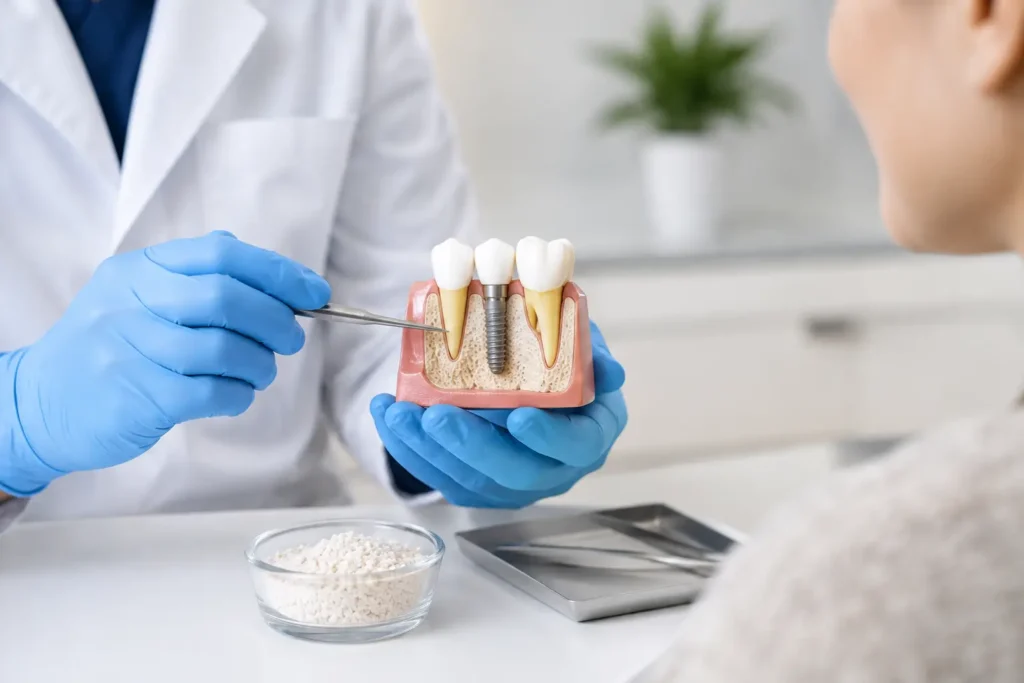
A missing tooth changes more than a smile. Over time, the jawbone in that area can lose volume, which may affect whether an implant has the stable foundation it needs. So, do implants require bone grafts? Not always. Many patients can receive implants without grafting, while others need a small or more advanced graft to create the support required for a secure, natural-looking result.
The right answer comes from a detailed clinical assessment, not from a one-size-fits-all treatment package. For patients considering dental implants in Istanbul, understanding this distinction can make the planning process feel far more confident and transparent.
Do Implants Require Bone Grafts in Every Case?
No. Dental implants are small titanium or ceramic posts placed in the jawbone to support a crown, bridge, or full-arch restoration. For an implant to perform well over the long term, it needs enough healthy bone around it for stability and proper integration.
If the bone is sufficiently wide, tall, and dense, an experienced implant dentist may be able to place the implant directly. This is often possible when the tooth was lost recently, when the surrounding bone has been preserved, or when the implant site naturally has strong bone volume.
A bone graft becomes more likely when a tooth has been missing for a long time. After extraction, the body gradually resorbs bone that no longer receives the stimulation of a tooth root. Gum disease, infection, trauma, previous failed dental work, and the natural anatomy of the upper jaw can also reduce the bone available for implant placement.
Grafting is not a sign that treatment has gone wrong or that you are not a candidate for implants. It is a planning tool that can make implant treatment safer, more predictable, and more aesthetically refined.
What a Bone Graft Does for an Implant
A bone graft adds or rebuilds bone at the planned implant site. The material may be processed donor bone, synthetic material, animal-derived mineral, or, in select cases, bone taken from another area of the patient’s body. Your dentist selects the material and technique based on the size and location of the defect, your health history, and the final restoration planned.
Over time, the graft serves as a framework for your own bone to grow into the area. The goal is not simply to fill an empty space. It is to create a stable base that can hold an implant in the correct position while supporting the contours of the gumline and smile.
This matters especially in visible front-tooth areas. Even if an implant could technically be placed in limited bone, inadequate support may compromise the final appearance. A carefully planned graft may help avoid a crown that looks too long, a recessed gumline, or a shadowed area around the restoration.
Common Types of Bone Grafting
Socket preservation is often performed at the time a tooth is removed. Graft material is placed into the extraction socket to reduce the bone loss that naturally follows extraction. This can make a future implant simpler, although it does not guarantee that no additional graft will be needed.
A ridge augmentation rebuilds bone that has become too narrow or too short for an implant. This is commonly considered when a tooth has been missing for months or years.
In the upper back jaw, a sinus lift may be recommended when the sinus cavity sits close to the area where upper molar implants are needed. The procedure gently creates additional bone beneath the sinus floor. It sounds complex, but it is a familiar procedure for implant-focused specialists when properly planned.
For smaller deficiencies, grafting may be completed at the same appointment as implant placement. For more significant bone loss, the graft usually needs time to heal before the implant is placed.
How Dentists Decide Whether You Need a Graft
A panoramic X-ray offers useful information, but modern implant planning should go further. A 3D CBCT scan allows the clinical team to assess bone height, width, density, nerve locations, sinus position, neighboring tooth roots, and the ideal angle for the implant.
The assessment also considers the condition of your gums. Active periodontal disease must be controlled before implants are placed. Healthy gum tissue and a stable bite are central to long-term success, particularly for patients receiving multiple implants or full-mouth restorations.
Your dentist will also look at factors that affect healing. Smoking or vaping, uncontrolled diabetes, certain medications, teeth grinding, and a history of gum disease do not automatically rule out implants, but they may change the treatment sequence or require additional protective measures.
An elite implant plan starts with the final smile, then works backward. Rather than placing implants wherever bone happens to be available, a skilled team plans for the final crown, bridge, or full-arch restoration first. That prosthetically driven approach helps balance function, facial aesthetics, and long-term maintenance.
Can Implants Be Placed at the Same Time as a Graft?
Sometimes, yes. If there is enough existing bone to achieve initial implant stability, a dentist may place the implant and add graft material around it during the same procedure. This can reduce the total number of surgical visits and may streamline treatment for qualified patients.
However, immediate placement is not always the premium choice simply because it is faster. When infection is present, bone walls are severely damaged, or stability cannot be achieved, staging treatment is often the more conservative and reliable path. The graft is placed first, allowed to heal, and the implant is inserted later.
Healing times vary. A minor graft may require only a few months before the next phase, while larger grafts and sinus lifts can require longer. After implant placement, the implant also needs time to integrate with the jawbone before the final restoration is fitted. Your exact schedule depends on your biology, the complexity of the case, and whether you are receiving a single implant or a complete smile restoration.
For international patients, timing deserves special attention. A clinic should clearly explain whether your plan can be completed in one visit, requires a second trip, or can include a temporary restoration while the implant heals. A beautiful temporary smile can be valuable, but it should never be presented as the same thing as a fully integrated final implant result.
What Grafting Means for Your Istanbul Treatment Plan
Choosing dental care abroad should not mean accepting vague clinical details. Before traveling, ask for a clear preliminary review of your dental images and a realistic explanation of what may change after an in-person examination and 3D scan.
A reputable treatment plan should distinguish between the implant fixture, abutment, final crown or bridge, temporary restoration, graft material, membranes, sedation if needed, and follow-up requirements. If bone grafting is a possibility but not confirmed until imaging is completed, that should be communicated directly rather than hidden inside a broad estimate.
The financial trade-off is straightforward: grafting can add cost and time, but skipping a clinically necessary graft can create greater expense and disappointment later. Implants placed without adequate support may be harder to clean, less stable, or less attractive at the gumline. The most valuable plan is not necessarily the shortest one. It is the plan that protects the outcome you came for.
Travel coordination also matters when surgical stages are involved. Patients should have appropriate recovery time before flying, a clear medication plan from their treating clinician, and practical guidance on meals, oral hygiene, and contact procedures after they return home. Concierge coordination can make the experience more comfortable, but clinical decisions must always remain with the licensed dental team.
Questions Worth Asking Before You Commit
Ask whether the dentist has reviewed a CBCT scan or whether a graft recommendation is based only on a standard X-ray. Ask how much bone is available, where the deficiency is located, and whether an implant can be placed at the same time as the graft.
It is also reasonable to ask what material will be used, how long healing is expected to take, and what restoration you will wear during that period. If you are considering full-arch implants, ask whether grafting can be avoided through a different implant design or placement strategy – and whether that approach is appropriate for your anatomy rather than simply more convenient.
Finally, ask who will manage your restoration and follow-up care. Implant dentistry is a partnership between surgery, restorative planning, and ongoing maintenance. Clear answers signal a clinic that values precision over pressure.
The Best Implant Plan Is Built Around Your Bone
Some patients need no graft at all. Others benefit from a modest graft that protects both implant stability and the polished finish of the final smile. Neither outcome is inherently better – what matters is that your treatment is based on detailed diagnostics, sound clinical judgment, and a plan that respects your timeline.
At Fix Dental Consultation, patients can begin with guided coordination and a clearer path toward matched care in Istanbul. The most reassuring next step is simple: obtain your imaging, ask direct questions, and allow the treatment plan to earn your confidence before you travel.