A missing tooth can change more than a photograph. It can affect how confidently you speak in meetings, what you order at dinner, and whether you smile without thinking about it first. When weighing dentures versus implants, the right choice is rarely about one treatment being universally better. It is about selecting the restoration that fits your oral health, timeline, budget, aesthetic goals, and comfort expectations.
For many American patients considering high-value dental care in Istanbul, this decision also involves planning treatment with confidence from a distance. A clear clinical assessment, transparent treatment plan, and coordinated travel experience can turn a major dental decision into a well-managed smile transformation.
Dentures Versus Implants: The Core Difference
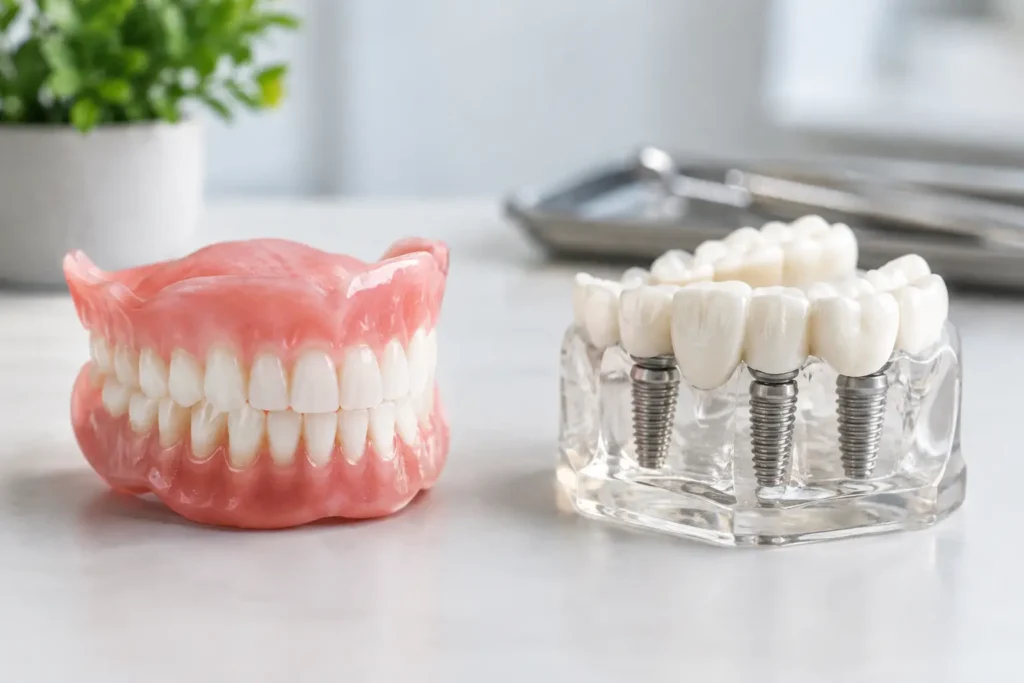
Dentures are removable prosthetic teeth designed to replace several teeth or an entire arch. They may be full dentures for patients missing all teeth in the upper or lower jaw, or partial dentures for patients who still have healthy natural teeth. Modern dentures can look refined and natural, especially when carefully designed around facial proportions, gum color, and bite.
Dental implants are small titanium or ceramic posts placed into the jawbone to act as artificial tooth roots. Once the implant integrates with the bone, it can support a single crown, a bridge, or a full-arch restoration. Unlike a removable denture, an implant-supported restoration is secured in place and designed to function more like natural teeth.
The distinction matters because dentures replace visible teeth, while implants can replace both the visible tooth and the root beneath it. That root-level support can influence chewing stability, jawbone preservation, and the way a restoration feels day to day.
When Dentures May Be the Better Choice
Dentures remain a valuable restorative option, particularly for patients who need an efficient solution or are not ready for implant surgery. A conventional denture can often be made with fewer clinical stages than a full implant treatment, making it a practical option when time is limited.
They can also be an appropriate choice when a patient has significant bone loss, complex medical considerations, or a preference to avoid surgery. While bone grafting and advanced implant techniques may expand eligibility for implants, not every patient wants the additional treatment time or investment involved.
A well-crafted denture can restore the appearance of a complete smile, support facial contours, and improve speech and eating compared with having missing teeth. Yet patients should enter treatment with realistic expectations. Removable dentures can shift slightly during eating or speaking, may require adhesive for added security, and need periodic adjustments as the gums and jawbone change over time.
For some patients, a removable denture is not the final destination. It can serve as an immediate or transitional solution while healing takes place before implants are placed. This can be especially useful after extractions, when the mouth needs time to stabilize before a definitive restoration is designed.
The Lifestyle Considerations of Dentures
Dentures are removed for cleaning and typically overnight. That routine is manageable for many people, but it is different from brushing and flossing natural teeth. Certain foods, especially firm, sticky, or crunchy items, may require more caution. Patients who value the convenience of a non-surgical option may find these trade-offs entirely acceptable.
The fit also matters enormously. Premium materials and precise clinical design can make dentures feel more comfortable and look more lifelike, but no removable appliance behaves exactly like teeth anchored in bone.
Why Many Patients Prefer Dental Implants
Dental implants are often chosen for their stability, longevity, and natural feel. Because implants are secured in the jaw, they can provide a strong foundation for chewing and speaking. A single implant crown can replace one missing tooth without relying on adjacent teeth, while implant bridges and full-arch solutions can restore more extensive tooth loss.
For patients with loose traditional dentures, implant-supported dentures can be a particularly compelling middle ground. Depending on the treatment plan, a removable overdenture may snap securely onto implants, or a fixed full-arch restoration may be placed so that only the dentist removes it during maintenance visits.
Implants may also help preserve jawbone in the area where a tooth has been lost. When a tooth root is absent, the bone can gradually resorb. This process can change facial support and make future restorations more complex. Implant placement does not eliminate every risk of bone change, but it provides the stimulation that a missing root no longer supplies.
The aesthetic advantage can be substantial as well. A carefully planned implant restoration is customized for tooth shade, shape, gumline, and facial harmony. For image-conscious patients seeking a polished, enduring result, that level of design is often a central reason to explore implants.
The Commitment Behind Implant Treatment
Implants require surgery and a healing period. In straightforward cases, treatment may involve placing the implant, allowing it to integrate with the bone, and then attaching the final restoration. More complex cases may require extractions, bone grafting, sinus lifting, gum treatment, or staged healing before the final teeth can be placed.
This does not make implants unsuitable. It simply means the plan must be personalized. Smoking, uncontrolled diabetes, active gum disease, teeth grinding, certain medications, and inadequate bone volume can affect treatment timing and long-term success. A responsible provider will review your health history, take appropriate imaging, and explain whether immediate loading is appropriate or whether a staged approach offers a more predictable result.
Implants also need consistent maintenance. They cannot get cavities, but the gum and bone around them can develop inflammation if plaque is not controlled. Professional cleanings, daily home care, and a protective nightguard when grinding is present are part of protecting your investment.
Comparing Cost Without Looking Only at the Initial Price
The upfront cost of dentures is usually lower than the cost of implant treatment. That difference can make dentures attractive, especially when multiple teeth need to be replaced. However, the initial price should not be the only factor in the decision.
Dentures may need relining, repairs, replacement, or adjustment as oral tissues change. Implant restorations also require long-term maintenance and may eventually need repair or replacement of the crown, bridge, or prosthetic components. The question is not whether one option has maintenance costs and the other does not. The better question is which investment aligns with the function, confidence, and longevity you want from your new smile.
For patients exploring care abroad, a detailed quote should identify what is included: diagnostics, extractions if needed, implant components, temporary teeth, final restorations, medication, follow-up planning, and any necessary coordination services. A low starting price without clarity can create avoidable uncertainty later.
How to Choose Between Dentures and Implants
Start with your clinical foundation. A comprehensive exam should evaluate remaining teeth, gum health, bite, jawbone volume, and any signs of infection or decay. High-quality imaging, often including a 3D scan for implant cases, helps the clinical team plan safely and accurately.
Then consider how you want your restoration to function in ordinary moments. If you want a removable, lower-commitment solution and are comfortable with periodic adjustments, dentures may meet your needs beautifully. If stability, stronger chewing function, and a fixed feel are priorities, implants may justify the added treatment process.
It is also reasonable to choose a hybrid approach. Some patients receive implants to support a removable denture rather than pursuing a fully fixed arch. Others replace only the teeth that need implants while retaining healthy natural teeth. The best plan preserves what can be preserved and restores what cannot.
Planning Implant or Denture Treatment in Istanbul
International dentistry should feel organized, not uncertain. Before traveling, patients should have a preliminary review of dental records or images when available, an understanding of the anticipated treatment phases, and realistic expectations about whether a final restoration can be completed during one trip or requires a return visit.
At Fix Dental Consultation, patients can receive U.S.-based guidance while treatment coordination is arranged through an affiliated network of Istanbul dental providers. Support with clinic matching, scheduling, communication, transportation, accommodations, and travel-related details helps create a more composed experience around an important clinical decision.
The strongest treatment plans do not force a choice based on marketing language or a single price. They account for medical suitability, long-term maintenance, appearance, and the life you want to return to after treatment. A thoughtful consultation is the place to ask direct questions, review the proposed materials and timeline, and choose the solution that lets you smile, eat, and travel forward with greater confidence.